 In May 2026, the 13th World Urban Forum (WUF13) was held in Baku — the first time the forum had ever come to our region.
On the sidelines of the event, the SPECA Cities Forum — bringing together Almaty, Arkadag, Bishkek, Dushanbe, Ganja, and Samarkand — officially became fully operational. The idea is to turn climate adaptation from an abstract goal into a standing mechanism for cooperation between cities.
The main outcome of WUF13 itself was the “Baku Call to Action,” which focuses primarily on the global housing crisis but treats housing and climate justice as inseparable, emphasizing finance, multi-level governance, and community participation. Like the urban declarations that came before it, it offers few concrete, measurable targets or accountability structures.
Declarations and forums are only the tip of the iceberg. The real question is what happens at street level — in specific courtyards, rivers, and the air of cities. This is where members of the CAN EECCA network have been working for years, and their experience shows what climate resilience in a city actually consists of.
What’s Wrong with Cities in Central Asia
Central Asia is one of the most climate-vulnerable regions on the planet. The Tian Shan and Pamir glaciers, which feed the region’s major rivers, are melting at an accelerating rate, raising the risk of water shortages for the cities that depend on them. On top of this come prolonged droughts, dust storms, and the shrinking of the Caspian and Aral Seas.
The region’s cities add a set of problems entirely their own. First, there’s chaotic high-rise construction that blocks air circulation. Second, there’s rising motorization: even where authorities are investing in public transport, urban infrastructure is simultaneously being rebuilt to accommodate a growing number of private cars — a shift that damages air quality, undermines road safety, and literally crowds out pedestrians and alternative ways of getting around.
As Tajik climate change expert Natalia Idrisova puts it:
“A significant but underrepresented problem is the dense, chaotic construction of poor-quality high-rises, which physically block cities’ natural ventilation, degrade air quality, and intensify noise pollution. The construction boom is accompanied by tree-cutting and the paving-over of land with concrete, which strengthens the urban heat island effect and places an added burden on residents’ health.”
How Residents Are Monitoring the Air Themselves
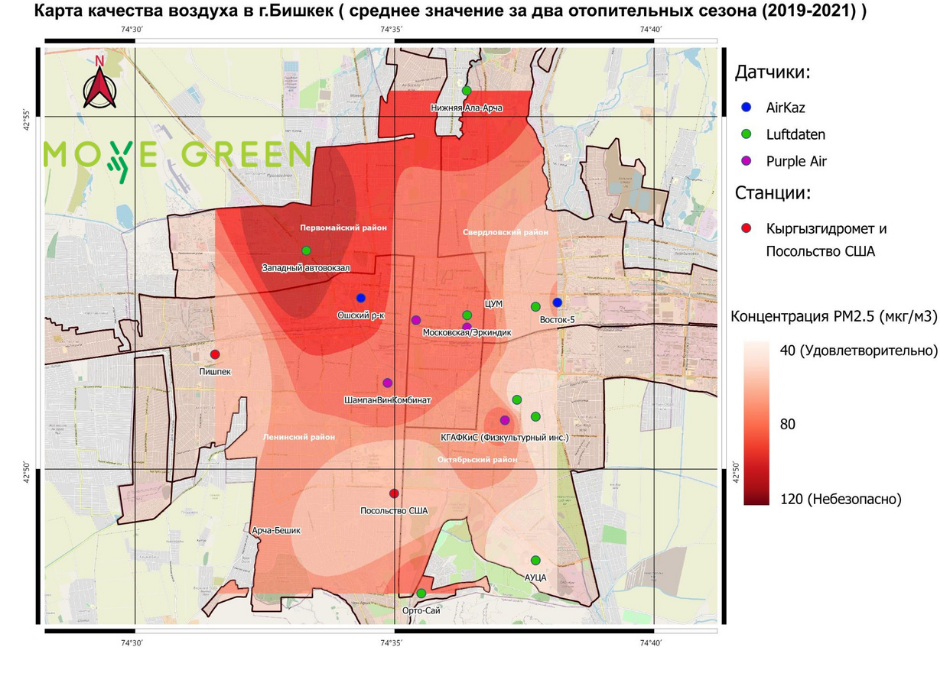
Systematic civic air quality monitoring in Kyrgyzstan began in 2017, at the initiative of MoveGreen. The organization began installing low-cost sensors, first in Bishkek and later across other regions of the country, to give residents access to timely, independent data on air conditions alongside official government information.
Data alone wasn’t enough. Alongside building out its monitoring network, MoveGreen launched a broad public information campaign — explaining the causes of air pollution, the health effects of fine particulate matter, and possible ways to address the problem, while organizing public actions and peaceful marches in defense of the right to clean air.
In its early years, this work met with a mixed reception, drawing pushback from both ordinary residents and government officials. Even so, sustained pressure from MoveGreen, environmental activists, and other civil society organizations helped make the smog problem impossible to ignore: in 2018, the country’s leadership publicly acknowledged for the first time that Bishkek had a smog problem, and in 2019, with MoveGreen’s involvement, a special commission on air quality in Bishkek was established. That work later evolved into a more systematic interagency mechanism, and the government began drafting regulations and policy measures aimed at reducing air pollution.
To help residents track air quality in a more accessible format, MoveGreen also developed the AQ.kg mobile app.
“Our broader goal is to build public understanding of the problem — what smog actually is, what it’s made of, how it affects health, and why air quality needs to be treated not just as an environmental issue, but as a social one,” says Azat Muradyl.
Over time, MoveGreen expanded beyond Kyrgyzstan, becoming one of the founders of AQCA (Air Quality Central Asia), a regional platform bringing together experts and civil society organizations to share data and experience.
Today, due to legal restrictions in Kyrgyzstan on air and water quality monitoring, the organization can no longer run civic monitoring at its former scale — but it continues working through research, climate education, journalist training, and nature-based solutions, including vertical greening.
The impact of this work goes beyond data and an app: the smog issue has become something the public actively discusses. In Bishkek — a city that regularly ranks among the most polluted in the world — the #BishkekSmog initiative, founded by activist Bermet Borubaeva, has spent years pushing the smog issue into public view, from civic air quality monitoring to pressuring city authorities for concrete measures: controlling emissions from heating plants, regulating private coal heating, and expanding public transport.
“Starting in 2019, we ran a series of #BishkekSmog protest actions in various formats — and the result was policy documents on reducing air pollution that the authorities ultimately adopted,” says Bermet Borubaeva.
The campaign also moved beyond the street: together with eight-time Emmy winner Andrew Tkach and Iskender Aliev, activists produced the #BishkekSmog documentary, which was released in four languages, screened in numerous countries, and won Best Environmental and Climate Film at the “Bir Duino Kyrgyzstan” International Documentary Film Festival.
That same combination of protest and sustained pressure also worked in the #ExtinguishItMrMayor campaign, which succeeded in getting the city’s landfill fire put out by municipal workers — even though the $20 million the European Bank for Reconstruction and Development (EBRD) allocated for the landfill’s remediation has effectively stalled, and the newly built replacement site still hasn’t been brought into operation.
The outcome was worse when it came to public transport: Bishkek’s city administration stopped running the trolleybuses it had upgraded with $22 million from the same EBRD-funded project — even as the city struggles with a shortage of public transport and rising car use. More than 600 employees of the Trolleybus Authority lost their jobs, many of them dismissed in violation of labor law. Nearly a year later, a complaint filed with the bank’s independent accountability mechanism still hasn’t received a response.
“Trolleybuses are the cleanest form of transport we have, and we need them to protect the most important thing we have — our health and our lives. This case shows that priority has to go to sustainable transport, and that major infrastructure projects also have to be held accountable for how they’re actually implemented,” says Borubaeva.
Coping with Unbearable Heat
Year after year, Bishkek residents complain about aggressive tree-cutting in the city: as the mayor’s office keeps widening roads, it keeps removing the trees that line them. MoveGreen works with the mayor’s office and municipal authorities to show, with concrete examples, how greenery affects heat and cooling in the city.
One such example is the “1,000 Green Walls” project: vertical greening of building facades and fences in places where there’s no room left to expand conventional planting. Pilot green walls have gone up at ten sites across Bishkek, supported by the mayor’s office and UNEP.
According to MoveGreen’s estimates, the potential of vertical greening in Kyrgyzstan is 22.5 times greater than that of horizontal greening — it lowers the surface temperature of buildings, improves the local microclimate, and helps trap dust and particulate matter, including PM2.5 and PM10, with particularly noticeable effects near schools, homes, and streets with heavy traffic.
“Vertical greening can’t be treated as a standalone solution to the smog problem. It won’t replace upgrading the heating system, improving building energy efficiency, expanding public transport, or controlling vehicle emissions — those systemic measures still need to happen. But as one piece of a broader climate and environmental policy, it can help make Bishkek greener, more resilient, and more livable,” notes Azat.
How Art and Science Are Reconnecting a City with Its Water
Almaty is part of the transboundary Balkhash-Alakol basin, and what happens to Lake Balkhash is directly tied to the city’s water security. Kazakhstan’s Artcom Platform, the Balqashqa Qamqor (CareForBalqash) initiative, and Aspan gallery jointly organized the Art Collider Balkhash x Almaty program — an interdisciplinary school where more than 60 participants from Kazakhstan, Uzbekistan, and Tajikistan — scientists, environmentalists, artists, and residents — worked together on how to rethink the management of urban and rural water resources amid the climate crisis.
“Our Art Collider program ran as part of the public program for the ‘Interweaving Climate, Water, and Community’ exhibition. We’re now continuing the school’s educational program — this time in Almaty, as part of Art Collider Water Futures. In parallel, we’re continuing our research into the cultural landscape of Lake Balkhash. As part of that work, our interdisciplinary team has several more research trips planned, which will let us dig deeper into the connections between water, culture, local communities, and the environment,” says Aigerim Kapar.
What Other Cities Can Learn
These examples point to a common logic that applies to any city in the region:
- The problem needs to be defined locally and concretely — not “the climate crisis” in the abstract, but “air quality in this specific city” or “water security in this specific basin.”
- Grassroots data and resident coalitions respond to problems faster than official statistics or political decision-making — and in doing so, they set a pace that authorities might never have reached without pressure from below.
- Being transboundary isn’t an obstacle — it’s a precondition. Neither air nor water recognizes administrative borders, so durable solutions require the involvement of neighboring countries and cities.
Limitations Worth Talking About Openly
None of these initiatives solves the problem on its own — and nearly all of them run into the same wall: civil society organizations have the data, the expertise, and the public’s trust, but not the leverage to hold institutions accountable for their own decisions.
The story of Bishkek’s trolleybuses is a direct illustration: a complaint against the EBRD’s actions has gone unanswered for almost a year, while 600 people have already lost their jobs. Civic air monitoring can pinpoint the problem more precisely than any official statistics, but on its own it can’t modernize a heating system or a transport network — that requires decisions made by people other than activists.
Not every urban challenge in Central Asia has found a solution. For instance, according to Natalia Idrisova, cities across the region remain poorly inclusive: the needs of people with disabilities and limited mobility are still weakly reflected in urban planning. And in cities that are greening at all, regional environmentalists often point to flawed practices — planting invasive ornamental species and trees that require far more upkeep than native ones would.
There’s also a more structural limitation. Representatives of CAN EECCA who took part in the Regional Environmental Summit in Astana in 2026 noted that at major intergovernmental venues, the voices of local communities and independent environmental organizations carry little weight — the agenda there tends to be set by business and political interests rather than by the people who are the first to feel the consequences. That creates a gap between the declarations on climate-resilient cities signed at these forums and what actually happens on the ground.