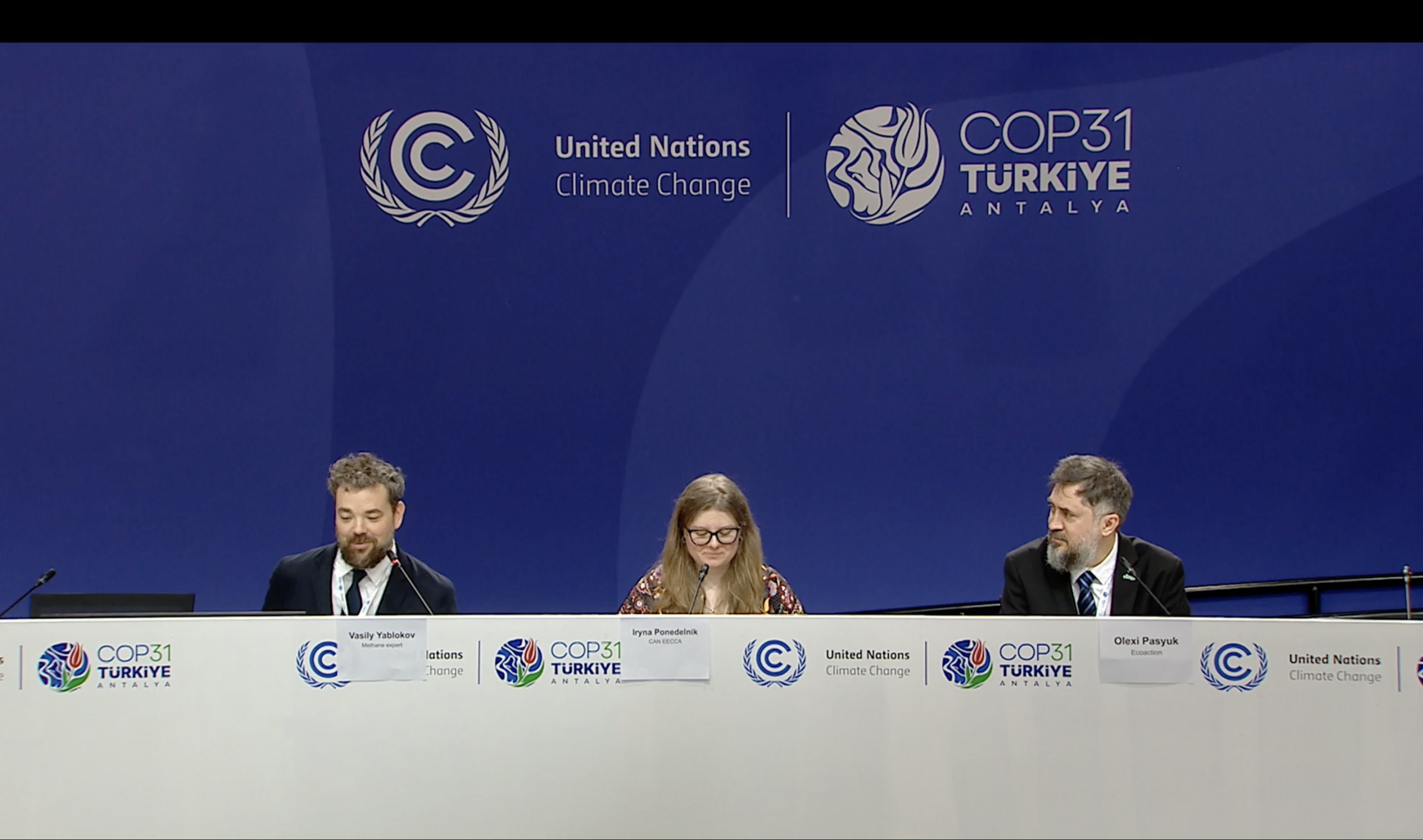
 Antalya, 13 November 2026. At a press conference at COP31, civil society experts from Eastern Europe, the Caucasus and Central Asia warned that new nuclear reactors and continued reliance on gas are false solutions to the climate crisis for the region. The press conference was organised by the Research-Intellectual Club “Dialogue of Generations” (RICDOG) and Climate Action Network Eastern Europe, Caucasus and Central Asia (CAN EECCA). It presented two new CAN EECCA positions, one on nuclear energy and one on methane emission reductions.
Nuclear: “too slow, too expensive, too dangerous”
Opening the press conference, Iryna Ponedelnik, Coordinator of CAN EECCA, presented the network’s position on nuclear energy.
“Nuclear power in our region is a false solution to the climate crisis. It is too slow, too expensive and too dangerous,” said Iryna Ponedelnik. “Climate science gives us this decade to act, and we cannot spend it waiting for reactors.”
The region also knows the risks first-hand. This year marked 40 years since the Chornobyl disaster, which affected more than 800,000 people. Central Asia still holds more than 800 million tonnes of waste from Soviet-era uranium mining and processing. Heatwaves and water shortages already force reactors to shut down, yet new plants are being planned in Central Asia, one of the most water-stressed regions in the world.
“In wartime, a nuclear plant stops being a power station and becomes an instrument of nuclear blackmail. Rejecting nuclear does not mean supporting fossil fuels. We reject both. A safe, affordable and sovereign energy future for our region is possible, and it can start today.”
CAN EECCA calls on governments in the region to:
- stop new nuclear and new fossil fuel projects, and end subsidies for them;
- put energy savings, efficiency, solar, wind and geothermal first, together with storage and modern grids;
- redirect public and international finance to renewables and regional cooperation;
- guarantee transparency, independent regulation and real public participation, including for communities still living with the Soviet nuclear legacy.
The process of developing the network’s position was facilitated by Svetlana Mogilyuk (ECOM, Kazakhstan). She stressed that choosing nuclear power contradicts the basic principles of sustainable development.
“The position of most organisations in the network is that nuclear power is a poor solution for reducing climate impact. Why? First, because it is a very slow solution, while action is needed far more urgently, and many renewable energy technologies deliver results much faster. Second, it is a very expensive solution that requires enormous resources, diverting them from other ways of reducing climate impact,” said Mogilyuk.
Finally, according to Mogilyuk, nuclear power is dangerous. The entire cycle, from mining the raw material to producing energy, generates extremely hazardous waste. Over time, the structures of nuclear plants themselves become radioactive, which means enormous costs for decommissioning, the process of returning a plant’s site to a safe state. There are still no adequate solutions for managing radioactive waste. In effect, today’s generation is passing decommissioning and waste on to future generations. This directly contradicts the principle of sustainable development: not to worsen living conditions for the next generations or place excessive costs on them.
Ukraine: “not secure and not independent”
Oleksii Pasiuk, Executive Director of Ecoaction (Ukraine), noted that over the years of climate negotiations most Parties have come to recognise that nuclear power cannot be a systemic solution within the UNFCCC framework. Pro-nuclear initiatives come from individual Parties and have not become mainstream. Even so, they distract from the Convention’s main task: phasing out fossil fuels and scaling up renewables. Nuclear power is not renewable, because it depends on uranium.
Pasiuk pointed out that nuclear power does not bring energy independence, even to countries rich in uranium. Uranium has to be processed into nuclear fuel, a technology held by only a few countries and closely tied to non-proliferation concerns. Several Central Asian countries are planning new reactors with the Russian state company Rosatom, which means building long-term dependency on a single supplier. The same dependence persists in the European Union, where countries operating Russian-designed reactors have struggled to switch to alternative fuel. As a result, sanctions target Russian fossil fuels but largely leave nuclear materials untouched. Pasiuk added that Rosatom is likely to face sanctions sooner or later because of its role in Russia’s occupation of Ukraine.
He described the nuclear risks Ukraine is living with during the war. The Zaporizhzhia nuclear plant is occupied and has effectively been turned into a military base. It has lost its external power supply almost 50 times. Without power, the cooling systems stop working, which can lead to a major accident, the same scenario seen at Fukushima. The shelter at the Chornobyl site was also hit by a Russian drone and now has a hole in it. An international effort is under way to raise half a billion euros to repair it.
“Anybody considering new nuclear in the region is putting too much risk on their people, and on their security and independence,” he concluded.
Methane: fast cuts need binding rules and open data
Vasiliy Yablokov, methane expert, presented CAN EECCA’s new position on methane emission reductions. The position was inspired by UN Secretary-General António Guterres’ call to action at London Climate Action Week and adopted by the network’s members.
“Methane is one of the fastest ways to reduce climate impact. It is responsible for about a third of global warming, and in sectors like energy it is a cost-efficient way to cut greenhouse gases in the very short term, within the next five years,” said Yablokov.
In the region, methane comes from oil and gas infrastructure, coal mines, livestock and waste. Countries have made uneven progress: some have national targets, while others still need targets, institutions and resources to deliver them.
“Kazakhstan announced here at COP31 plans to use satellite data in national methane regulation, connecting detections with action by regulators and operators and verifying repairs. That is a timely example. The next questions are clear: who must respond, by what deadline, what information will be public, and how progress will be independently checked,” said Yablokov. “There are many super-emitters in Central Asia that can be eliminated in the next few years, significantly reducing the carbon footprint of industry across the whole region.”
The CAN EECCA methane position sets out five priorities:
- National targets and effective rules: measurable methane targets in national climate commitments, sector plans with binding measures, and mandatory requirements for large sources, with voluntary initiatives encouraging further progress.
- Practical measures across sectors: regular leak detection and repair, an end to routine venting and flaring, and controls on operating and abandoned coal mines; support for proven measures in agriculture, with finance and advice for smaller farms; and prevention of food and organic waste, separate collection and landfill gas capture.
- Monitoring, reporting and verification: moving from engineering calculations to direct measurement and independent data, with detected releases triggering a mandatory response.
- Transparency and participation: public data on significant emission sources and achieved reductions, and a role for civil society, scientists and affected communities.
- Finance, fairness and health: polluters paying for compliance, international support for public institutions, municipalities, small farms and abandoned sources, consistent standards for export and domestic supply chains, and recognition of air quality and health benefits.
Read the positions
Media contact
Iryna Ponedelnik, can.eecca@gmail.com