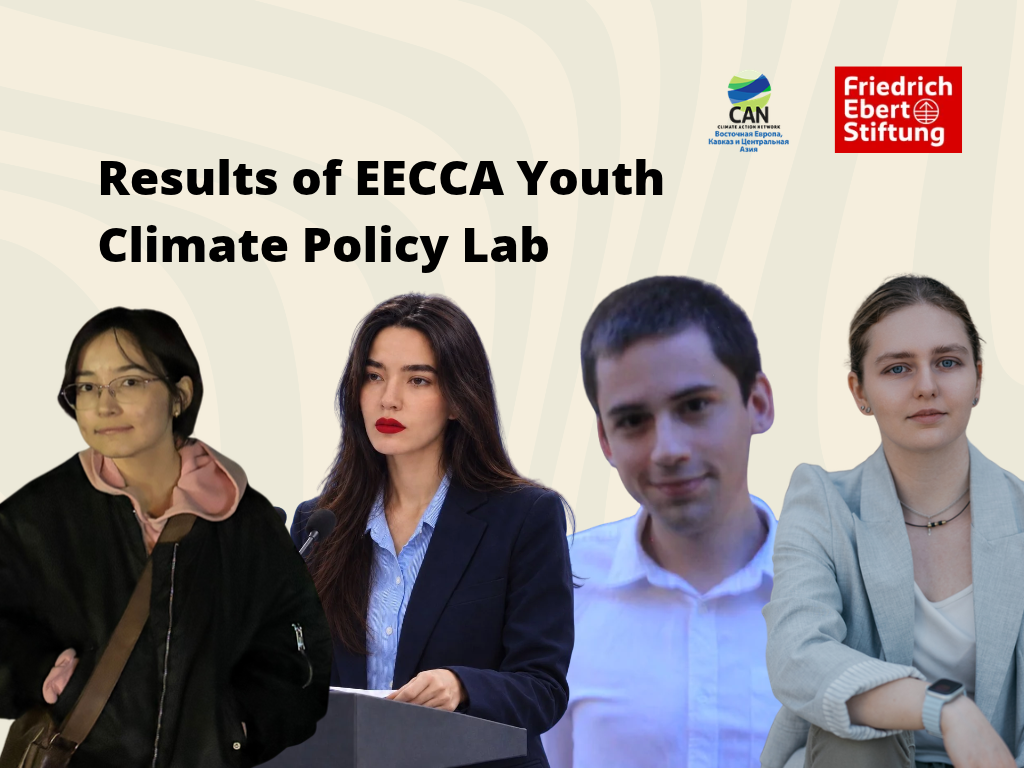
 This year, Climate Action Network Eastern Europe, Caucasus and Central Asia (CAN EECCA), with the support of the Friedrich-Ebert-Stiftung (FES), ran the EECCA Youth Climate Leadership School, a programme that helps young people from the region turn their knowledge and concerns about climate change into policy-relevant work.
As part of the School, nine selected participants from Azerbaijan, Belarus, Georgia, Kazakhstan, Ukraine and Uzbekistan took part in one-on-one mentorship. Working with experienced mentors, they produced policy briefs, analytical articles and a podcast on the issues that matter most in their countries: water and energy security, air pollution, public health, green buildings, nature-based solutions, cultural heritage, the legacy of Soviet colonialism and the environmental risks of post-war reconstruction.
“The programme’s main focus was policy communication and its formats, because a policy brief is not always the right solution. It is important for us to show that decision-makers also listen to podcasts, read the media and follow social networks, and that it is sometimes easier to reach them through different communication formats”, shared Iryna Ponedelnik, Coordinator, CAN EECCA.
ell beyond the programme itself. Two pieces were published in international outlets, The Diplomat and Tuta Magazine. All publications were featured in CAN EECCA’s weekly digests, sent to about 1,470 subscribers in Russian and 160 in English, and our social media series on the mentees’ work gathered nearly 11,000 views.
What the mentees produced
Water, energy and the WEFE Nexus
Kamila Fayzieva (Uzbekistan) examined why Central Asia’s shift to clean energy cannot succeed without securing water resources first. Her work led to an analytical article in The Diplomat and an accompanying policy brief.
- Article: Central Asia’s Energy Transition Depends on Water Security (The Diplomat)
- Policy brief: Can Central Asia’s Energy Transition Succeed Without Water Security?
Air quality and health
Arailym Seipilova (Kazakhstan) turned data she collected on air pollution in her home city into a policy brief on how residents and authorities have come to accept dirty air as normal, and what can be done about it.
- Policy brief: Normalization of Air Pollution in Karaganda
A young researcher from Belarus (name withheld for security reasons) analysed how climate change is affecting public health in the country.
- Policy brief: Climate Change and Health in Belarus
Cities and buildings
Kristina Ryabova (Kazakhstan) looked at how green building requirements could be built into the construction of public schools in Kazakhstan.
A young researcher from Azerbaijan (name withheld for security reasons) explored how nature-based solutions can make Azerbaijan’s cities more resilient, and discussed the topic further in a podcast episode.
Justice, heritage and finance
Zurab Kochladze (Georgia) wrote about Soviet colonialism and its lasting legacy of environmental injustice across the EECCA region.
Vera Haponava (Belarus/UK) showed how Belarus’s peatlands both store carbon and preserve the country’s cultural heritage.
Tymur Pliushch (Ukraine) analysed the environmental risks of the international money flowing into Ukraine’s reconstruction. Policy brief: Green Recovery of Ukraine: Environmental Risks of International Financing and Mechanisms for Their Prevention
In their own words
Zuka, Georgia:
“Without hesitation, I can say the mentorship experience was amazing. I applied because I wanted to hear about climate change from the perspective of my own region. My advice to anyone considering a future cohort: don’t overthink it, if you’re interested, apply. It gave me the chance to work on the topic I care about most, Soviet colonialism and environmental injustice, alongside a mentor I came to know as resilient, sharp, and genuinely inspiring. To really achieve environmental justice in the EECCA region, it is necessary to truly decolonize our minds.”
Kamila Fayzieva, Uzbekistan:
“Challenging, in the best possible way. My mentor was supportive, rigorous, and thoughtful. The work I developed during the mentorship became the basis for an analytical article in The Diplomat.”
Arailym, Kazakhstan:
“For me it was challenging. I wanted this program to help me turn the data I gathered about air pollution in my city into something meaningful and actionable.”
Kristina Ryabova, Kazakhstan:
“The mentorship was empowering. My mentor was structured, experienced, and encouraging.”
Young researcher, Belarus (name withheld for security reasons):
“Challenging. My mentor was inspiring, hardworking, and empathetic.”
A mentor’s perspective
Anisa Abibulloeva, mentor:
“It was a pleasure to contribute to the EECCA Youth Climate Policy Lab as a mentor, sharing my expertise and supporting the development of analytical climate journalism. The region has a growing need for high-quality, insightful, and thought-provoking reporting that examines emerging policy priorities, particularly the Water-Energy-Food-Environment (WEFE) Nexus. I particularly valued the opportunity to support a young journalist in exploring this complex and increasingly relevant topic, helping to strengthen informed public discourse and promote a more integrated understanding of the region’s interconnected sustainability challenges.”
Looking ahead
The School showed how much young people in Eastern Europe, the Caucasus and Central Asia can contribute when they have time, guidance and a platform. Their work brings regional perspectives into debates that are too often framed from outside, and it gives decision-makers concrete, evidence-based proposals.
Iryna Ponedelnik, Coordinator, CAN EECCA:
“It is important for us to work with young people and engage them in climate policy. We continued the mentorship programme because we believe it is important to build connections between the network’s member organisations, experts and young people: we see great potential in this work. We very much hope to cooperate with FES again in the future and to keep developing the region’s youth potential together.”
We thank all the mentees and mentors for their commitment, and FES for its support. We invite you to read, listen to and share the mentees’ work, and to follow CAN EECCA’s channels for news about future cohorts. As one of our participants put it: if you’re interested, apply.