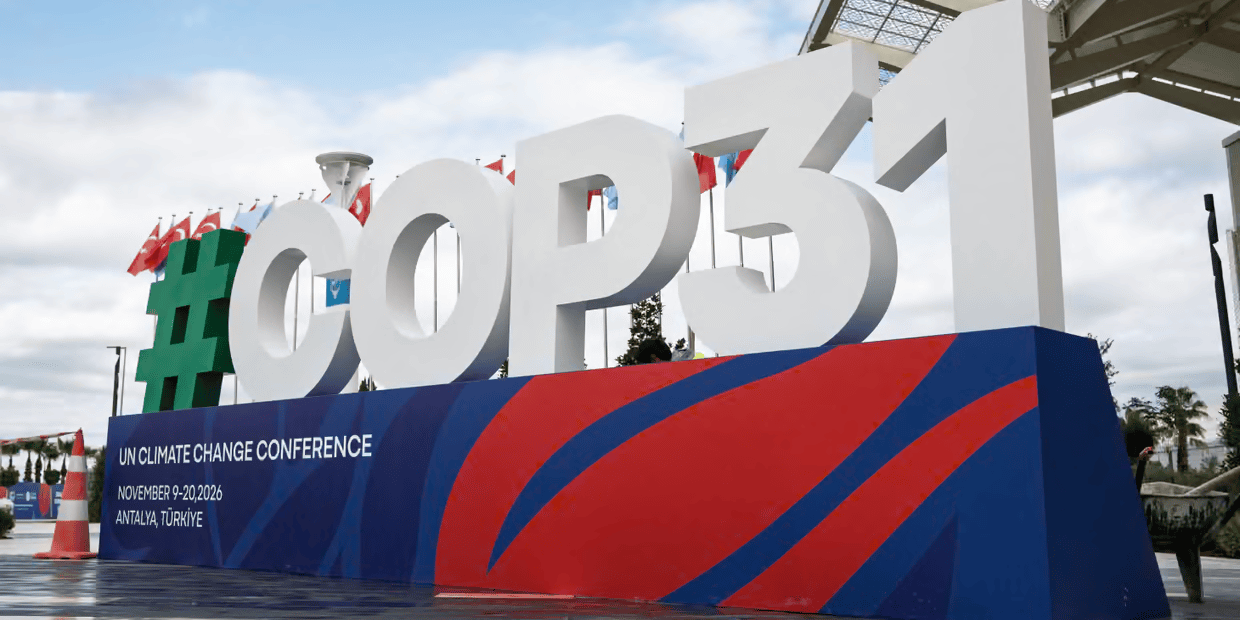
When world leaders gathered in Antalya on 11-12 November, the Leaders’ Summit opened on the third day of COP31 with heads of state and government from around 100 countries expected to attend. Türkiye’s President Erdoğan reaffirmed his ambition to make COP31 an “Implementation COP”, turning commitments into action. The turnout was thinner than at past summits. Preliminary UN figures showed 77 leaders scheduled to speak, almost a third fewer than the 116 who spoke at COP28 in Dubai.
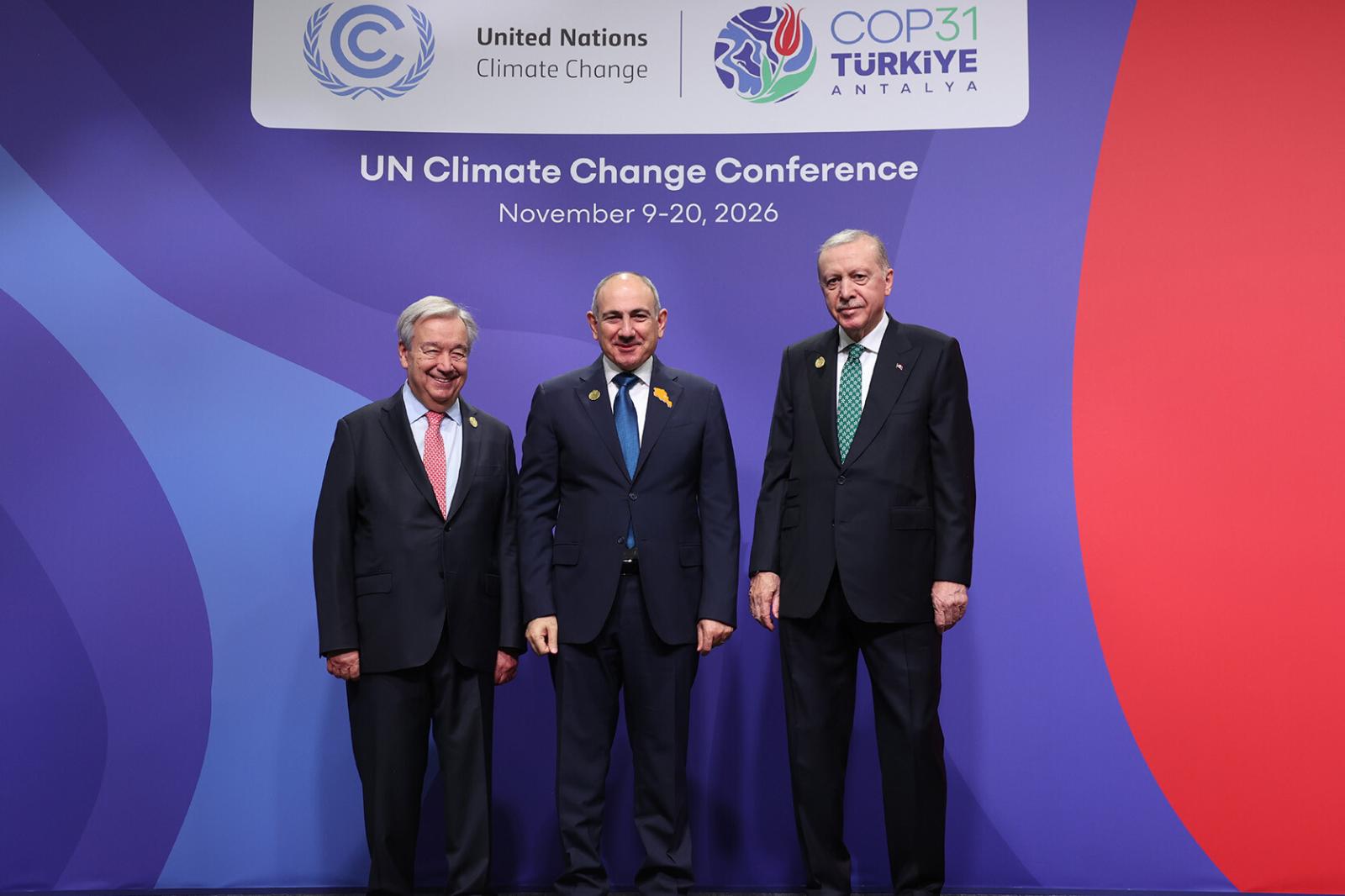 The EECCA region was represented at the highest level by several countries. Azerbaijan’s President Ilham Aliyev was welcomed by Erdoğan and UN Secretary-General António Guterres. Armenian Prime Minister Nikol Pashinyan attended the opening ceremony. Uzbekistan’s President Shavkat Mirziyoyev presented a three-part “Climate Integration Model” for coordinating regional responses to melting glaciers, water scarcity and drought, and confirmed that Uzbekistan will chair the International Fund for Saving the Aral Sea in 2027. Kazakhstan’s delegation was present at the conference, and the country planned to sign around 28 cooperation documents at COP31.
The stakes are high. The conference opened with an early fight over finance, as the UN chief urged world leaders to “get serious” after a year of devastating weather extremes. At the summit, Brazil’s President Lula criticised what he called attacks on science and multilateralism, and Guterres proposed a “climate justice compact”. For EECCA, the issues are concrete: financing for adaptation and the energy transition, shared water and glacier risks in Central Asia, and the gap between national targets and delivery.
Leaders’ presence matters because negotiators can only go as far as their governments allow. A head of state who stands at the podium and announces a target, a financing partnership or a regional initiative is tying their government to it, and civil society can then hold them accountable.
Coordinator of Climate Action Network Eastern Europe, Caucasus and Central Asia (CAN EEECCA), Iryna Pondedelnik:
“The Leaders’ Summit is a chance to show that the countries of Eastern Europe, the Caucasus and Central Asia are not just watching the climate crisis from the sidelines, but are ready to help address it. Our region is already feeling the consequences of climate change: melting glaciers, droughts and water shortages. If leaders want the region’s voice to be heard, they need to be here, at the negotiating table, with concrete commitments. CAN EECCA welcomes the participation of the leaders of our countries who were able to come to COP31 and present their positions. Attendance at the highest level is a signal that the region takes its future seriously. The Leaders’ Summit is the moment for the region to make itself heard, not to leave empty seats. A just energy transition begins with political will at the highest level.”
Below we look at what EECCA leaders said, and the reactions of EECCA civil society.
Kazakhstan
“Addressing environmental challenges requires closer cooperation,” said Kazakh Prime Minister Olzhas Bektenov. He proposed an international water organisation under UN auspices, reaffirmed the 2060 carbon neutrality goal, and said renewables’ share of electricity has quadrupled in six years to 8%, with a 15% target for 2030. On the Taza Qazaqstan movement, he said, “We invite all interested partners to join this process. The Taza Qazaqstan initiative has grown into a nationwide movement with over six million participants, and nearly 1.7 billion trees have been planted in five years, with 270 million more seedlings planned for 2027.”
Among other projects, he highlighted the Green Energy Corridor with Azerbaijan and Uzbekistan, the low-carbon Alatau City and the use of AI and satellite monitoring to forecast natural hazards.
Lyudmila Petrova from NGO “Angel”, Kazakhstan:
“Prime Minister Olzhas Bektenov’s address at the COP31 Leaders’ Summit outlined several important directions for our country’s climate and environmental policy. For Kazakhstan, especially given growing climate risks, this is not only an environmental issue but also a matter of public safety, food security and the future of rural areas. That is why the initiative to create an International Water Organization under the auspices of the UN deserves particular attention. On the development of renewable energy and the Green Energy Corridor with Azerbaijan and Uzbekistan, it is important that the energy transition is accompanied not only by the construction of new facilities, but also by real emission reductions, improved energy efficiency, and new opportunities that are accessible to the regions.”
On the Taza Initiative, Petrova said: “It is very important that the environmental agenda is becoming part of public life. However, environmental responsibility should not be limited to tree planting and cleaning up public spaces. It also means conserving water resources, managing waste, protecting ecosystems and adapting to climate change. We need to see how national climate goals are being implemented in specific regions, small towns and rural communities. To achieve this, it is important to develop public monitoring, openness of climate data and the participation of civil society, including young people”.
Kyrgyzstan
Chairman of Cabinet of Ministers Adylbek Kasymaliev delivered the national statement for Kyrgyzstan. He backed the commitments to mobilise $1.3 trillion a year in climate finance by 2035 and to triple adaptation funding, and called for simpler access and fewer administrative barriers. He announced a Global Center for Mountain Region Resilience and called for support for the Issyk-Kul trust fund, to which Kyrgyzstan has pledged $10 million. He also invited participants to the Second Global Mountain Summit in Bishkek in October 2027.
Bermet Borubayeva, of the #BishkekSmog initiative reacted:
“We support the key points of the speech by Adylbek Kasymaliev, Chairman of the Cabinet of Ministers and Head of the Presidential Administration of the Kyrgyz Republic, at the global COP31 climate summit in Antalya, on supporting mountain communities, protecting Lake Issyk-Kul, and the need to change how international adaptation finance is provided. At the same time, such changes must also take place within Kyrgyzstan itself, so that citizens can participate directly in decision-making at the local level, and in monitoring and allocating funding. The bitter experience of the investment project in trolleybus infrastructure shows that millions spent on development can, in a single day, turn into a pile of scrap metal in a depot instead of sustainable transport. Instead, electric transport was replaced by gas-powered buses. Fossil fuel increases greenhouse gas emissions into the atmosphere, which potentially contributes to glacier retreat, as well as to the smog in Bishkek.”
Uzbekistan
President Shavkat Mirziyoyev told world leaders, “No country can address the challenges of climate change on its own,” and presented his three-part Climate Integration Model. It covers shared early warning and data systems, technologies against land degradation and dust storms, and adaptation finance with development banks. “Uzbekistan commits to sustainable water use, and we are seeing tangible results, — over a decade water consumption has fallen by nearly half. Central Asia needs reliable sources of finance, so we propose new instruments including concessional grants.”
Mirziyoyev announced that Uzbekistan will chair the International Fund for Saving the Aral Sea in 2027, and noted that the country has already cut emissions per unit of GDP by 35% ahead of schedule and aims for 54% renewables in electricity by 2030.
Nargis Kosimova, explaining the position of Ekolog.uz:
“The public association “Ekolog” welcomes the initiatives outlined by President of the Republic of Uzbekistan Shavkat Mirziyoyev in his COP31 speech, aimed at combating climate change, developing renewable energy, using water resources rationally and restoring ecosystems. The initiative to create a Central Asian Climate Integration Model is particularly significant. In the face of growing water scarcity, melting glaciers, droughts and dust storms, the countries of the region need to join forces, develop the exchange of environmental information and build effective early warning systems.
We also consider it important to strengthen the role of civil society in implementing climate policy. Environmental NGOs, journalists, scientists and local communities should be able to take part in developing, implementing and publicly monitoring environmental programs. Special attention should be paid to environmental education for young people, the development of an environmental culture and support for local conservation initiatives. At the same time, the effectiveness of climate commitments should be measured not only by the volume of investment, but by real results: improved air and water quality, preserved biodiversity and greater environmental safety for the population.”
Tajikistan
Sulaymon Ziyozoda, Deputy Prime Minister of Tajikistan announced the country’s plan to double renewable electricity generation by 2035, adding about 20 billion kWh a year, and called for more international climate finance, sustainable infrastructure and support for low-carbon industry.
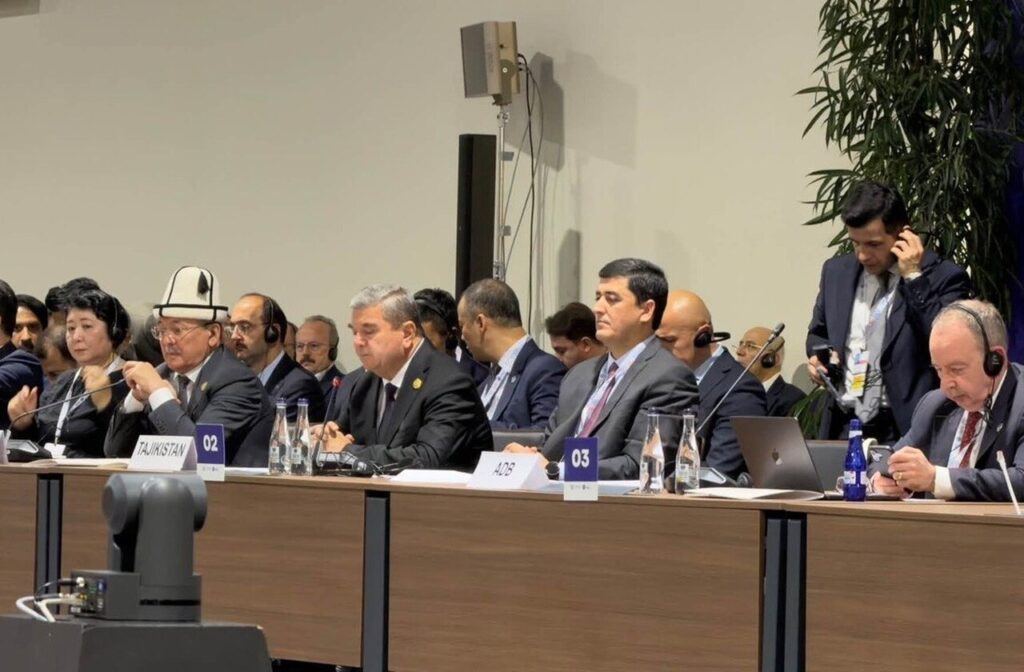 Timur, founder of the environmental initiative group “Medvezhiy Ugol”, Tajikistan:
The speech was, on the whole, quite good. As expected, it noted the country’s low greenhouse gas emissions and high vulnerability, Tajikistan’s international initiatives on water resources and glacier preservation, and its readiness to step up national climate efforts if international financial and technological support is available.
It is clear that the achievement of most of the goals and objectives set out in the Green Economy Development Strategy and the updated NDC mentioned in the speech depends largely on attracting external resources and using them effectively. Tajikistan cannot provide such financing on its own. And attracting large volumes of external or private investment requires serious legislative, institutional and other reforms. So what we see here is rather cautious optimism.
Peak emissions in the 1990 baseline year and their sharp decline after the collapse of the USSR allow Tajikistan to formally meet its climate commitments even if actual emissions gradually grow along with the economy.
The overwhelming share of the country’s electricity (about 94-98%) is generated by hydropower plants. However, fossil fuels account for around 60% of Tajikistan’s total primary energy supply / final energy consumption (coal used in industry and household heating, and petroleum products in transport). There is work to be done here.
Tajikistan has real potential for positive change, and we hope that the initiatives the country is promoting will be directed, among other things, at supporting the most vulnerable communities, which are the first to feel the impacts of climate change.
Armenia
Armenia’s Prime Minister Nikol Pashinyan attended the opening ceremony of the Summit, but it was Environment Minister, Hambardzum Matevosyan, who delivered Armenia’s national statement.
Matevosyan outlined Armenia’s approaches to climate change mitigation and adaptation, stressing the need for integrated solutions to environmental challenges. “Protecting and restoring forests and safeguarding the Lake Sevan ecosystem are important for conserving biodiversity, strengthening climate resilience and supporting the wellbeing of local communities.”
He referred to the declarations presented at COP17 in Yerevan and synergies between Rio Conventions.“Armenia expresses readiness to host the 34th Conference of the Parties to the United Nations Framework Convention on Climate Change (COP34) in Yerevan in 2029,” the minister summarised on his Facebook page later on.
Arshak Makichyan, Armenian climate justice activist:
“Armenian officials repeat the same generic statements at COP31, while Armenia has no comprehensive policies on either a just energy transition or environmental protection. Politicians remain silent on these issues when addressing domestic audiences, as if the climate crisis didn’t exist. Meanwhile, instead of protecting the environment and leading the region in climate action, they continue to approve controversial mining projects that threaten Armenia’s environment.”
Moldova
In his address, Moldova’s Prime Minister Vasile Tofan spoke of water and energy challenges…
“In March this year, families in northern Moldova turned on their taps, but no water came out,” Vasile Tofan said, noting that a Russian attack on a hydropower plant in neighboring Ukraine caused oil to spill downstream into the Dniester River.
“After months of drought, the main upstream water reservoir was more than ten meters below its normal level. The government was preparing for the possibility that the pumps might run out of water. For a small country like Moldova, the consequences of war, climate change and environmental degradation do not stop at national borders. Neither can our response stop there. […] Just six years ago, renewable sources provided approximately 3 per cent of Moldova’s electricity. Today, that figure is approaching 30 per cent. But producing more clean energy is only part of the solution. We must also build the infrastructure needed to make full use of it.”
Moldova has committed to reducing its net greenhouse gas emissions by 75 per cent by 2035, compared with the level recorded in 1990.
 Elena Culighin, representative of Moldova’s National Environmental Council, shared:
“What stood out to me in Moldova’s COP31 statement was its emphasis on water security. Pollution linked to the war, left families in northern Moldova relying on emergency water deliveries. Months later, prolonged drought threatened water intakes on the same river, the Dniester. These experiences show why Moldova and Ukraine need to share monitoring data, warn communities quickly and prepare together for drought.
Moldova’s pledge to cut net greenhouse gas emissions by 75% by 2035 compared with 1990 levels goes hand in hand with its call for accessible, predictable climate finance. Moldova contributes little to global emissions, and its communities are already bearing the costs of climate change. For people along the Dniester, a practical measure of that finance is whether it helps keep safe drinking water available through the next prolonged drought.”