 In 2025, Kazakhstan should submit an updated Nationally Determined contribution (hereinafter referred to as NDC3.0). The document contains country plans to curb global temperature growth at 1.5 degrees Celsius.
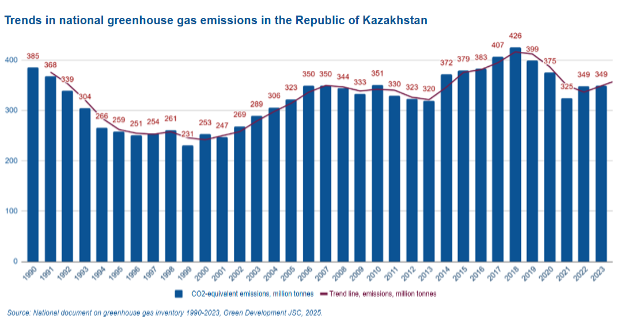
To implement the plans by the end of 2030, Kazakhstan has set a goal to reduce greenhouse gas emissions by 15%, and with sustainable international financing – by a quarter. This goal was documented for the first time in 2016 in NDC1.0 and duplicated in NDC2.0 after seven years. 1990 was chosen as the base year for determining the level of greenhouse gas emissions – the year of the adoption of the Declaration of State Sovereignty of the Republic by the Supreme Council of the Kazakh SSR.
NDC also defines the country’s ambitious plans to achieve the goals of the Paris Agreement on Climate Change. And it allows attracting international “green” financing for the implementation of advanced energy, agricultural and other technologies. They are the basis for reducing greenhouse gas emissions and, consequently, obstacles and/or adaptation to climate change.
Kazakhstan ratified the Paris Agreement of December 12, 2015 on November 4, 2016, followed by Turkmenistan. Tajikistan followed the example of its neighbors in 2017, Uzbekistan in 2018, and Kyrgyzstan in 2019.
The year 2025 is about to expire, and so far only Kyrgyzstan and Uzbekistan have updated NDC from the Central Asian countries. For Kazakhstan, the absence of this document means difficulties or even the inability to use the allocated “green” finances in the future.
Natalia Bachinskaya, consultant on climate, ESG and sustainable development issues, in a publication on her page following the results of the seminar “NDC in Kazakhstan. The dialogue on the formation of climate commitments” suggests that “On the one hand, more ambitious decarbonization goals are expected from Kazakhstan, on the other hand, the last NDC (dated 04/19/2023 – author’s note) is currently not supported by either a roadmap or a financial plan. It is encouraging that the development of a new NDC is accompanied by the development of an investment plan.”
Nevertheless, Kazakhstan’s achievements in implementing NDC2.0 are already impressive: greenhouse gas emissions have been reduced by almost 10%.
The expert also cites calculations by Zhasyl Damu JSC:
– To achieve the NDC’s goal of reducing emissions by 15% by 2035, it will take about 90 billion US dollars, with 20% – 104 billion US dollars. Obviously, there are not enough own funds. As for international financing, it is also insufficient. For example, development banks (ADB, EBRD) have allocated $250 million to Kazakhstan for green and gender projects together for the period up to 2030-2035.
The possibilities of the Paris Agreement
– Financing under Article 6 of the Paris Agreement is not credit money. The projects pay off through the sale of carbon units on the international market, some of which may remain in the country to ensure NDC. Kazakhstan’s potential under Article 6 is about 22-32 billion dollars. The country needs to take a number of steps, for example, to create a “positive” list of projects that will be allowed to be implemented with the involvement of international investments. There is already an understanding that this needs to be done, and this work is underway,” concludes Bachinskaya.
Discussing the draft Roadmap for the implementation of Kazakhstan’s Carbon Neutrality Strategy until 2060, one of the main documents contributing to the implementation of NDC plans at the Atameken NCE site, Dosym Kydyrbayev, Managing Partner of Rakurs Consulting Group LLP, noted that although the document has become structured, it requires building a unified logic with an emphasis on systemic and regulatory measures, as it will be difficult to attract green financing without clear coordination.
Meanwhile, Uzbekistan is implementing the policy crediting project under the mechanisms of Article 6 of the Paris Agreement. The project is estimated at $46 million, the first stage has been successfully completed and paid for. Morocco and Indonesia are developing regulations for similar projects. Kyrgyzstan is launching a 20,000-hectare forest climate project, and Kazakhstan initiated a similar 1,500-hectare project last year. In 2023, Vietnam adopted a mobilization plan for climate finance and is now a leader in the number of projects. In total, about 30 countries are already implementing Article 6 projects.
Competition for resources is increasing. Will Kazakhstan have time to take advantage of the opportunity?
Civil society is pushing for a more ambitious contribution
The recommendations of public figures for updating the NDC significantly exceed the earlier versions of the document in terms of measures taken.
Back in February 2023, at a meeting of the Public Council under the Ministry of Ecology and Natural Resources of the Republic of Kazakhstan, NGO experts recommended that the Department of Climate Policy and Green Technologies raise commitments to reduce greenhouse gases to 30% by 2030 as an unconditional goal and to 45% as a conditional goal. Add specific targets for fuel types and economic sectors to the document, and provide for a phase-out of coal starting in 2024.
This would be facilitated by a ban on the construction of new large coal-fired power plants, reduction of existing capacities during reconstruction by replacing them with renewable energy sources, and the introduction of measures to reduce methane emissions. Experts recommended supplementing the sections on adaptation and economic diversification with local climate adaptation plans with an emphasis on saving water and energy, landscaping, protection from natural hazards, adaptation of communal infrastructure, and the creation of public information and education systems in cooperation with NGOs.
The members of the CAN EECCA climate network also presented their recommendations for the development of NDC3.0 in August 2025. The attention of the network representatives was attracted by the lack of a detailed roadmap for the implementation of the current NDC2.0. In order to achieve full compliance with the trajectory of curbing global warming at 1.5 °C, experts recommend that Kazakhstan set a scientifically sound interim target for 2035.
The development and publication of strategies for the fair and phased out of fossil fuels with clear industry deadlines and plans for investments in renewable energy would significantly strengthen the NDC. It is also proposed to include a section on a Just transition in the document, with a focus on social protection, staff retraining and the participation of civil society in the implementation of climate policy. The updated NDC should contain separate and transparent accounting in the sectors of land use and agriculture with clearly defined sustainable development goals. These measures are critically important to prevent the growth of poverty and inequality in the face of increasing climate risks.
By the way, the conditional current target of Kazakhstan of 25% is assessed by Climate Action Tracker as “almost sufficient”, while the unconditional target of 15% is considered “insufficient” in accordance with the country’s fair contribution to the fight against climate change. With CO2 emissions per capita of 12.55 tons compared to the global average of 4.67 tons, Kazakhstan will need to significantly reduce its emissions through more ambitious policies and actions. And NDC3.0 can become a fundamental tool for solving these problems.
Business proposals for the development of a new NDC
The Kazakhstan ECOJER Association did not stand aside and presented its proposals for the NDC3.0 project until 2035. The main focus is on developing clean energy and setting realistic targets to reduce emissions. Data from more than 600 industrial projects were used for calculations.
Given the critical dependence on coal-fired generation for heat supply, experts suggest offsetting emissions by increasing the share of renewable and alternative energy, including nuclear power plants, to 27%, and raising the unconditional goal to 17%. ECOJER representatives emphasize the need to introduce a 10-year forecast carbon price range. Since at the current price of less than $ 1 per ton, a business can realize only a small part of its decarbonization potential: 7.7 out of 39.6 million tons of CO2. And to reform the tariff policy to account for the costs of decarbonization. In their recommendations, ECOJER experts also focused on intensifying efforts to attract financing under Article 6 of the Paris Agreement.
What is already known about NDC3.0?
The first public consultations were held in December 2024. Vice Minister of Ecology Mansur Oshurbayev said that the updated NDC will focus on the abandonment of coal, the development of renewable energy sources and energy efficiency. He stressed that without joining forces, “NDC3.0 would be able to will become another stupid document that won’t work.” Aida Aliyeva from the NDC Partnership noted that Kazakhstan’s NDC will include a chapter on losses and damage that cannot be adapted to, and the target for reducing emissions can be increased to 16%. At the same time, Kazakh expert Bulat Yessekin believes that NDC’s focus should be on ecosystem restoration.
Director of the Climate Policy Department of the Ministry of Ecology and Natural Resources Saule Sabieva reported at the round table of the KAZENERGY 2025 international forum that the agency considers NDC 3.0 as an opportunity for technological renewal of the country.
In February 2025, the Minister of Ecology and Natural Resources of the Republic of Kazakhstan discussed with representatives of the international organizations NDCP, UNDP, FAO, UNICEF, UNITAR, GIZ, CCAS and the expert community the key aspects of the formation of NDC3.0 until 2035. It was clarified at the meeting that the development of NDC3.0 will be based on the LEAP (Long-range Energy Alternatives Planning System) model. The Ministry intends to develop the document “in close collaboration with key stakeholders, including government agencies, the business community, academia and the civil sector.”
In the final version, it is NDC3.0 most likely, solutions will be proposed to neutralize the environmental impact of coal-fired power plants.
According to the chairman of Climate for Us, Alimkhan Abulkhan, in the updated NDC3.0 It is planned to allocate a separate chapter on youth and children. It can be based on a youth appeal prepared based on the results of the National Youth Conference on Climate Change LCOY Kazakhstan 2025 and the recommendations of the UNICEF office in Kazakhstan.
At the opening of PowerTech 2025 on April 2 in Almaty, Vice Minister of Ecology and Natural Resources of the Republic of Kazakhstan Mansur Oshurbayev announced the ministry’s intentions to publish NDC3.0 by the end of October 2025. However, at the time of writing and publishing the article in November, there is no draft document on the Open Regulatory Legal Acts
Helena Garkava