Review our Regional Position on COP30.
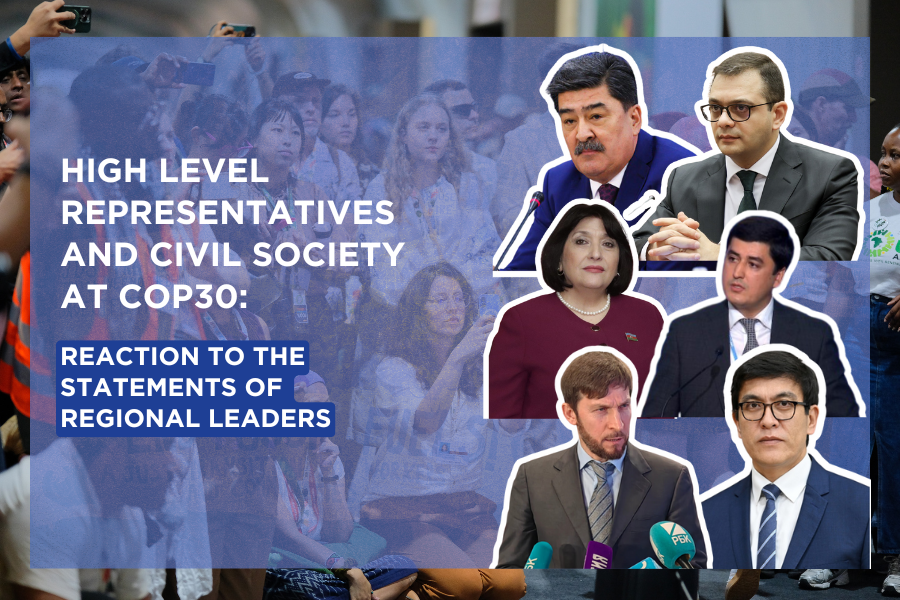
On 6–7 November, the Leaders’ Summit at COP30 took place in Belém, Brazil — a key platform where world leaders presented their positions on global climate policy. Unlike last year’s COP29 in Baku, when many heads of state from the EECCA region attended the high-level segment in person, this year most countries were represented by ministers or other officials.
For example, the presidents of Central Asian countries did not participate personally, as they were in Washington for a meeting with Donald Trump during the Summit. Nevertheless, civil society in the region carefully assessed the content of their statements.
How did the leaders of the region present their climate positions at COP30, and what is civil society’s response? Experts from CAN EECCA provide insights below.
Armenia
At the high-level segment, Armenia was represented by Robert Abisogomonyan, Deputy Minister of Foreign Affairs.
In his statement, he emphasized that, despite Armenia’s small share of global emissions, the country intends to enhance its climate contribution through updated NDCs, the transition to low-carbon development, expansion of renewable energy while maintaining the role of nuclear power, and the adoption of a new climate law.
Special attention was paid to the interconnections between climate, biodiversity, and land degradation. As the host of COP17 on biodiversity, Armenia plans to promote integrated approaches and strengthen coordination between the Rio Conventions.
Statement at 6:02:45
Aram Gabrielyan, NGO “Khazer”:
Representatives of small-population countries often highlight their limited share of global emissions. However, the question arises: is this the best measure of impact? Would it not be more objective to assess impact per capita?
Regarding Armenia’s “updated 2026–2035 NDCs,” it should be noted that they have not yet been approved or published, and it is premature to claim that “they aim to ensure climate resilience of ecosystems and biodiversity.” In the draft released for public consultation, vulnerability and adaptation of ecosystems and biodiversity were not included. Nevertheless, the statement made an important and encouraging point on synergies between the Rio Conventions with a forward-looking perspective: “Armenia, as host of the 17th Conference of the Parties to the Convention on Biological Diversity, is taking active steps together with partners to strengthen international cooperation and promote integrated approaches to climate mitigation and biodiversity protection…”
Azerbaijan
Azerbaijan was represented at the high-level segment by Sahiba Gafarova, Chairperson of the National Assembly.
In her statement, she highlighted achievements during Azerbaijan’s COP29 presidency, including the adoption of the Baku Climate Finance Goal — mobilizing USD 300 billion annually by 2025 and increasing this to USD 1.3 trillion by 2035.
Other announced results included the launch of a Loss and Damage Fund, completion of rules under Article 6 of the Paris Agreement, and activation of the transparency framework. Gafarova also emphasized Azerbaijan’s intention to accelerate national climate targets and its readiness to support the COP30 agenda.
Javid Gara, Ecofront:
Specifically about her speech, she relied heavily on generic phrases that lacked any real action or accountability. She was just reading from a prescribed script, showing little emotional connection to the subject matter.
Regarding Sahiba Gafarova, she is the Speaker of the Parliament, represents a government structure where the parliament has limited power, both on paper and in practice. Essentially, she serves as a messenger—albeit a poor one. The lead negotiator, the Deputy Foreign Minister, is a respected official within the government. However, if he is the highest-ranking representative from Azerbaijan at COP30, it suggests that the Azerbaijani government does not take this conference seriously.
On the action front, Azerbaijan has yet to announce its net-zero target and has only slightly tightened its emission reduction goal for 2035. This commitment remains critically insufficient to meet the objectives of the Paris Agreement.
Russia
Russia was represented by Ruslan Edelgeriev, Special Presidential Envoy for Climate and Water Resources. He highlighted the need for balance between adaptation and mitigation, noting that the global agenda often focuses solely on emissions reduction while adaptation requires equal attention and financing.
Russia emphasized the role of forest ecosystems — from the Amazon to its own forests covering over 1 billion hectares and absorbing more than 1 billion tons of CO₂ annually — and presented systemic measures to prevent wildfires, including remote sensing and drone technologies.
Vladimir Slivyak, Ecodefense!
Russia has no plans for emission reductions, and its development strategy includes expansion of fossil fuel extraction and exports. Poor management threatens the carbon-absorbing capacity of forests. Russian representatives speak confidently at UN summits about international climate policy, yet domestic climate policy fails to meet any standard. As the world’s fourth-largest emitter, Russia must act — drastically reducing fossil fuel consumption, scaling up renewable energy, and ending the war in Ukraine.
Kazakhstan
Kazakhstan was represented by Erlan Nysanbayev, Minister of Ecology. He outlined national climate priorities, financial needs, and potential forms of international cooperation under the Paris Agreement. Additionally, he presented preliminary progress in preparing the Regional Environmental Summit in Kazakhstan in 2026, including launching regional consultations, developing climate finance mechanisms, and establishing a scientific exchange network.
(Commentary pending.)
Kyrgyzstan
Kyrgyzstan was represented by Edil Baisalov, Deputy Chairman of the Cabinet of Ministers.
He emphasized the moral and historical responsibility of developed countries for the climate crisis, the importance of mountain ecosystems for water security, biodiversity, and cultural heritage, and expressed concern over mountain degradation, glacial melting, drying rivers, and landslide risks.
Baisalov called for financing adaptation and resilience of mountain ecosystems, supported a just and differentiated transition from fossil fuels, and stressed the critical importance of recognizing mountains, forests, and oceans as a single system vital for the entire planet.
(Commentary pending.)
Tajikistan
Tajikistan was represented by Bakhodur Sheralizoda, Chair of the Committee on Environmental Protection under the Government of Tajikistan.
He highlighted the critical threat of climate change to the country’s and region’s water resources due to glacial melting, mountain ecosystem degradation, and biodiversity loss.
Sheralizoda noted the potential of renewable hydropower to achieve climate goals, reported on the first international high-level conference on glacier preservation in Dushanbe, and the creation of a UN-managed trust fund for glacier conservation.
(Commentary pending.)
Representatives of Uzbekistan, Belarus, Ukraine, and Moldova did not participate in the Leaders’ Summit.
Iryna Ponedelnik, Climate Expert, Belarus:
Belarus traditionally maintains a passive stance in international climate forums. Its absence from the high-level segment in Belém underscores the lack of political will to engage in global climate dialogue. Even when Minsk attends COPs, participation is largely formal: no coalition-building, no presentation of initiatives, with a focus on EU and US sanctions — topics unrelated to necessary domestic climate actions. One should not expect Belarusian negotiators to contribute anything new or constructive, despite claims of “active participation.”
Maria Kolesnikova, Chairperson of the CAN EECCA Board:
The first week of COP30 has made it clear that without freedom of speech, genuine dialogue, and an independent civil society, true climate justice is impossible. In our region, where people live amid war, pressures on democracy, and increasing climate vulnerability, human rights are not an abstraction—they are a daily necessity.
Climate finance, NDCs, and the transition away from fossil fuels will only work if people have the ability to be heard and to influence the decisions that determine their lives and health. We continue to advocate for transparency, access to information, and real protection for those carrying out climate work on the ground, often under very challenging conditions.
The transition to clean energy must be accompanied by care for people—their rights, their safety, and their future. Climate policy must be human-centered; otherwise, it will simply not work.