Hosting COP30 in Belém, Brazil posed major challenges for EECCA countries. High travel and accommodation costs — with one-bedroom apartments reaching up to USD 1,000 per night — combined with visa requirements and complex logistics, severely limited participation for many delegates. As a result, the region was underrepresented, weakening its ability to advocate effectively during negotiations.
The absence of EECCA presidents from the Leaders’ Summit was another notable signal. Instead of taking part in key climate discussions, Central Asian presidents chose to attend a meeting with Donald Trump, who himself ignored COP30 entirely and did not send an official delegation.
The most significant outcome of COP30 was the adoption of the Belém Just Transition Mechanism — a decision civil society had long pushed for. For EECCA countries, another major development was the long-awaited release of updated NDCs 3.0 by most of the region: eight countries submitted their new documents, with the exception of Tajikistan, Georgia, and Armenia. This creates a basis for more transparent and comparable regional climate policies.
On the sidelines of the negotiations, Russia received the “Fossil of the Day” award for emissions linked to its full-scale war in Ukraine and for systematically obstructing key agenda items — from gender equality and just transition discussions to adaptation finance.
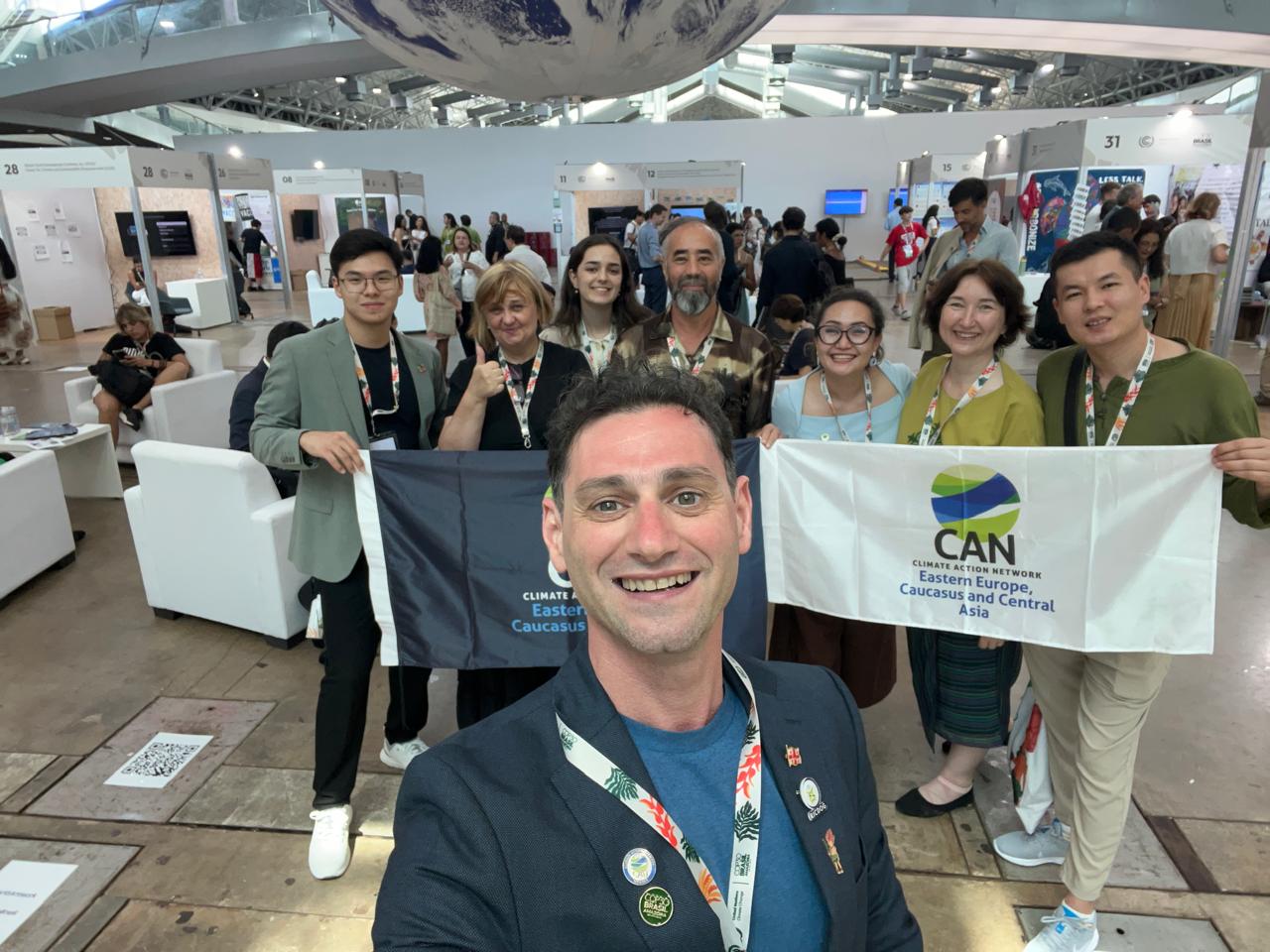
CAN EECCA members who represented their countries at COP30 reflect on what mattered most for national priorities, regional interests, and climate action at home — from updated NDCs and mountain agendas to adaptation, green energy, and support for vulnerable communities.
Nugzar Kokhreidze
Board Member, Assistant of Interim Coordinator of Secretariat of the CAN EECCA, Georgia
For me, COP30 was less effective than expected: the absence of several key countries put many decisions at risk. A positive element was progress on the BAM and the announcement of new NDCs by EECCA countries. However, this is not enough — the region needs far more ambitious targets and a clear vision for just transition policies and adaptation plans. Some governments stated they are working on such frameworks, but real implementation is still distant. CAN EECCA will continue pushing for concrete actions, adequate financing, and protected civil-society participation to ensure COP30 outcomes do not remain mere declarations.
Lyudmila Petrova
Public Association “Angel”, Kazakhstan
For me, COP30 was an important platform to advance the priorities of Kazakhstan and the wider EECCA region. A particularly significant milestone was Kazakhstan’s announcement of its updated NDC, which places stronger emphasis on adaptation and the role of regions. This is an important step that also shapes the direction of our NGO projects. Kazakhstan also announced preparations for the Regional Environmental Summit 2026, aimed at strengthening the region’s contribution to global climate processes.
At the WHO Pavilion, I presented the experience of Kazakhstani NGOs — particularly PA “Angel” — in engaging communities and vulnerable groups in climate dialogue. I was glad to see growing attention at COP30 to health and climate risks, which are increasingly viewed as a connected agenda.
What remains concerning is the still insufficient progress on adaptation finance for our region. However, I was encouraged by how united and active the EECCA civil society community was throughout the conference.
Thank you to CAN EECCA for the support — we will continue strengthening our region’s voice.
Gulshan Akhundova
“Women, Development, Future” Public Union, Azerbaijan
COP30 in Belém left a very strong impression. Despite some organizational challenges and the hot, humid weather, the overall atmosphere was dynamic and open. There were occasional logistical difficulties when moving between venues, but they did not hinder productive work or active participation in sessions.
For Azerbaijan, COP30 was an important opportunity to present its priorities — from water resources and adaptation to the promotion of green energy. Our meetings and discussions showed strong partner interest in regional climate initiatives and confirmed that Azerbaijan’s role in global climate processes is growing.
The conference outcomes indicate that countries increasingly recognize the need to accelerate climate action. Even though the final decisions were compromise-based, they reflect a commitment to move forward on climate finance, support for vulnerable regions, and strengthening civil society participation.
For me personally, participating in COP30 was a valuable professional experience: I felt genuine engagement from participants and saw that each country’s contribution — including Azerbaijan’s — truly matters.
Gulmira Esengeldi
«MoveGreen», Kyrgyzstan
For Kyrgyzstan, COP30 was a significant moment to elevate the mountain agenda and draw global attention to the vulnerability of high-mountain countries. We hope that the updated NDC 3.0 with more ambitious targets, along with the initiative to establish a Global Mountain Resilience Center in Bishkek, will receive broad support and evolve into real mechanisms for climate adaptation. We also expect discussions on protecting fragile ecosystems to move from words to action.
For MoveGreen, participating in COP30 provided even stronger motivation to continue our climate advocacy through education, research, and awareness campaigns aimed at promoting concrete climate measures with the involvement of all sectors. As health issues became one of the key themes at COP30, we plan to strengthen our focus on the links between climate change and public health, promoting integration of climate and health agendas into programs and community initiatives.